
Space Law Why Should you care?
The University of Ottawa’s Space Law Society contemplates similar questions
By Matthew Patten
- 2024-2025 Issue
Space, the final frontier. When people think of space, maybe they envision science-fiction like Star Wars or Star Trek, maybe scientists at Houston hunched over a table crunching numbers for a telemetry analysis, or maybe they think of astronauts blasting off. Whatever your first thoughts about space are, I doubt lawyers came to mind.
Law students might rightfully ask what is space law and why should I care?
Space is currently undergoing a renaissance with an explosion of activity. The annual number of launches into space has increased 12-fold in less than a decade from 211 launches in 2016 to more than 2,600 launches in 2023! Growing private interests, space tourism, and governments with explicit plans to establish permanent colonies on the moon and Mars are all part of this renaissance.
About the Author
Matthew Patten is the Associate VP Editorial for The University of Ottawa’s Space Law Society.
For more information, contact
spacelawottawa@gmail.com
At its core, space law seeks to develop and expand legal and regulatory frameworks to govern the use of space. As space law is such a novel area, there remains many policy and legal aspects to be clarified. These include questions around what are the rules for mining the Moon or asteroids? Who is responsible for cleaning up space debris? And is a satellite involved in military operations a valid target under international humanitarian law?
As future lawyers, we will be directly involved in answering these questions and more. Similar to how law students today question why we need to read cases from the 1800s, law students in 100 years will be reading the decisions on space that law students today will litigate during their careers as lawyers. Getting involved in space law now provides students with the opportunity to lay the foundation in the industry for things to come.
Law students at the University of Ottawa are uniquely poised to influence and participate in space law conversations through access to opportunities other schools do not have. uOttawa is one of the only schools in the country to have a dedicated course on Space Law, taught by Dr. Aram Kerkonian, a leading Canadian expert.
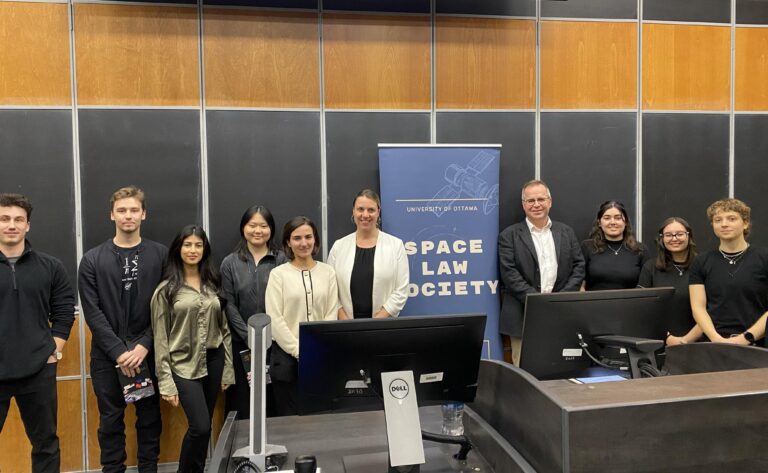
Being in the Nation’s capital, uOttawa students have a unique opportunity to be directly involved in government policies that impact the actions of private industry. For example, last year uOttawa’s Space Law Society (SLS) provided recommendations on the Canadian Space Agency’s (CSA) Modern Regulatory Framework of which two recommendations were adopted by the CSA. This fall the SLS provided input on Kenya’s draft ‘Space Bill’. The SLS has also helped secure jobs and student proposed internships for students in the field of space law.
Law students may be hesitant to learn about space, a niche that may be regarded as being reserved for scientists and engineers. This couldn’t be further from the truth. While certain elements of space law deal with science and engineering, space law fundamentally seeks to answer many of the questions lawyers have down on Earth. Law students may ask how their interests interact with space law? The proper question is which interests don’t.
Interested in animal welfare? What are the laws governing animal welfare in space-based scientific experiments?
Interested in criminal law? What laws apply to murder in space?
Interested in entertainment law? There’s an entire NASA team dedicated to ensuring movie depictions of space are accurate!
The overlap between space law and other areas of the law are as endless and infinite as space itself.
You don’t need to be a scientist or an engineer to get involved. Members of the SLS come from diverse backgrounds in political science, criminology, environmental studies, science, and engineering. Recently, the SLS held a speaker event which featured the preeminent space law scholar, Michael Byers whose background was originally in International Law. Before transitioning to a space lawyer, he had very little experience within the domain of space. He’s now an award-winning co-author (along with an astrophysicist) of the book ‘Who Owns Outer Space?’.
On a personal note, my interest in space law stems from natural resource development in space. Space mining was once thought to be a distant possibility, something that would only exist in sci-fi, but through the Artemis Program, the U.S is gearing up to make that possibility a reality before the end of the decade. This will open a world of questions related to international property rights, employment rights, and questions surrounding the re-emergence of colonization. It is my goal to be involved in laying out the legal framework that will govern this newly developing domain.
I hope that this article has shown students that within space law, there are opportunities for everyone. Regardless of where your interest lies, there’s a place for you in space law. Come and be part of the growing industry.