
Thousand and One Silhouettes: When Fashion Becomes Community
By Katie Mbakulo
Breaking the usual stillness of an evening in the halls of uOttawa, Thousand and One Silhouettes proved to be much more than a fashion show. What unfolded was not just a series of looks on a runway, but a space where culture was lived, shared, and made visible. Hosted by the uOttawa Fashion Law Society in collaboration with the Middle Eastern and North African Law Students’ Association, the event pushed beyond what we typically expect from a fashion show into something far more meaningful.
From the opening remarks, it was clear that this night was not about fashion in the usual sense. The focus was not on trends or aesthetics, but on what clothing can carry, such as memory, history, and identity.
For Shirin Tafreshi, VP of Events for the Fashion Law Society, the idea behind the show was deeply personal. “I’ve always loved sharing my culture with my non-Iranian friends… it brought me so much joy and brought us closer together,” she explained. That sense of closeness, using culture as a way to connect, became the foundation of the event.
What started as a fashion show quickly became something more deliberate. It was a way to showcase the richness of MENA cultures while also acknowledging the realities that those communities are facing today.
“We want students to leave feeling more connected to each other,” Shirin said, “and more aware not only of the beauty found in the culture of those regions, but also of the ongoing humanitarian hardships many communities there continue to face.”
That balance between celebration and awareness was one of the most striking parts of the night. The presence of the International Development and Relief Foundation (IDRF) further grounded that message. Founded in 1984, the IDRF responds to urgent humanitarian needs all over the world, including in the Middle East and North Africa, particularly to urgent appeals in Palestine, Lebanon, and Afghanistan.
Speaking to a reporter for Ex Curia, Regional Manager Khaled Jarrar emphasized why engaging with law students matters: “At this age group, you’re the people that [will] be running the country… it’s very important for us to build [a] relationship with you from this moment.”
Law students, he suggested, are not just future lawyers. They are future decision-makers, the people who will shape policy, influence systems, and determine what justice looks like in practice. Organizations like IDRF, he noted, offer “a fantastic channel for you to put your efforts,” whether through volunteering or long-term involvement.
Beyond the speakers and the structure of the event, what stood out most was the people behind it. For Joudy, co-president of MENALSA, the show carried a deeper meaning. “As a newcomer, it’s really important to have a sense of community, because you often feel like an outsider,” she shared. Having come to Canada as a refugee from Syria, that experience shaped how she approached the night, not just as an organizer but as someone who understands what it means to search for belonging.
“This show is so important,” she added, “because it gives us the opportunity to connect with one another and learn about each other’s cultures in a way that is more natural.”
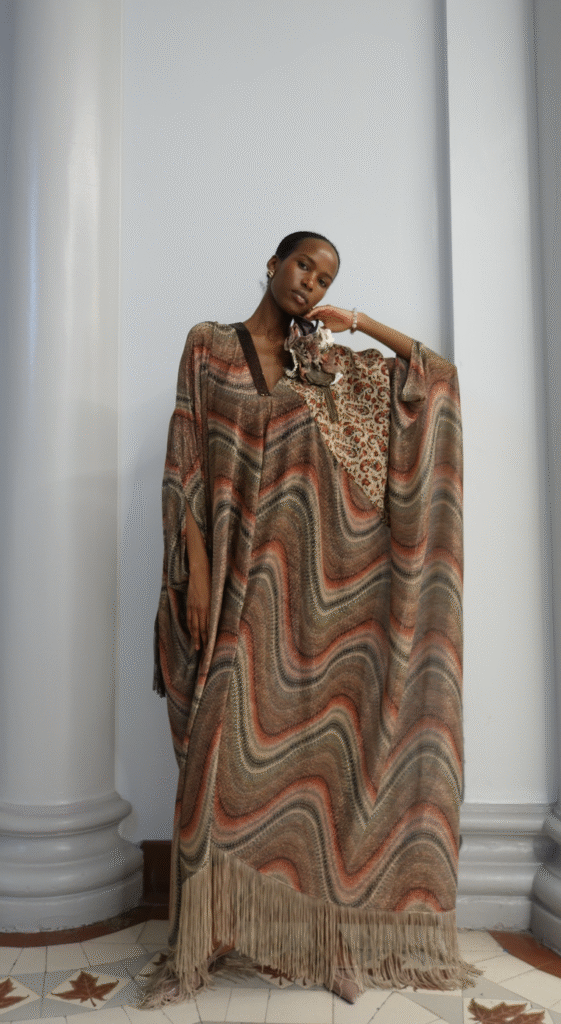
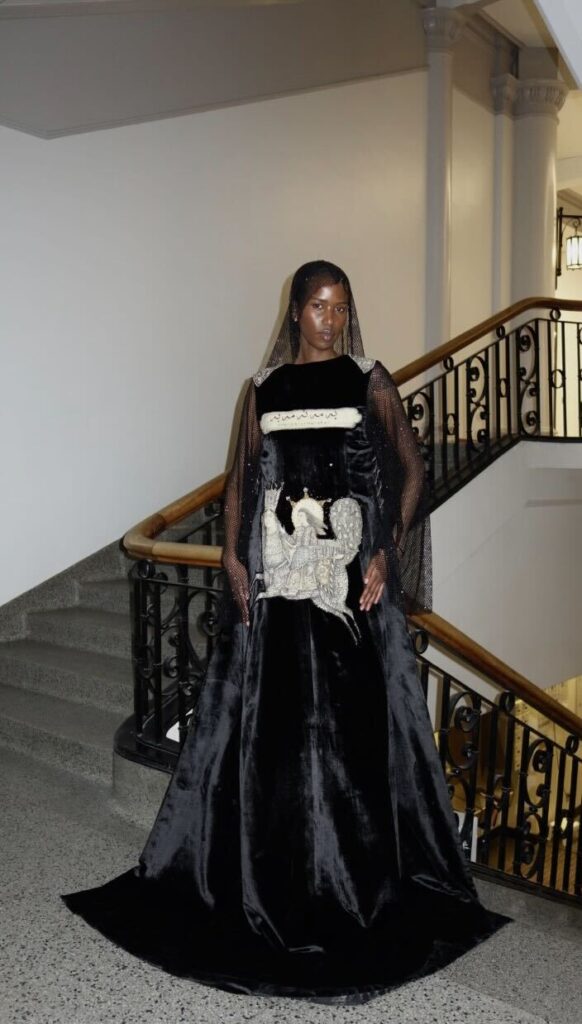
As the runway came to life, that authenticity became even more apparent. The garments moved between traditional and contemporary without feeling disconnected. One moment featured Palestinian thobes with detailed embroidery, followed by flowing Moroccan caftans, and even contemporary streetwear. Some pieces were bold and sparkling, others more reserved and traditional, each carrying its own story.
Pieces were either generously loaned by MENA students from their own cultural wardrobes, or contributed by MENA fashion designers such as Leyla Kashani. Leyla is a Toronto-based Iranian-Canadian designer whose work is dedicated to preserving Iranian textile heritage and traditional craftsmanship through fashion that is both ethical and innovative. Two pieces from her Resilience collection were showcased on the runway – a kaftan gown made from traditional Persian textile Termeh, and a garment featuring traditional Ghalamkar artwork by Iranian artist Sahar Mousavii – highlighting the richness and artistry of her culture.
It became impossible to see the MENA region as a single, uniform identity; instead, what emerged was diversity in its most genuine form, across countries, communities, and individual expression. That diversity extended beyond the clothing. The models, made up of university students, reflected a wide range of backgrounds, both MENA and non-MENA. Cultural celebration was presented not as something exclusive, but as something shared. For some in the audience, it was a moment of recognition, while for others, a fresh discovery.
In a law school environment, where there can sometimes be a narrow idea of what professionalism looks like, that kind of cultural diversity carries weight. “There’s often a very narrow or ‘hegemonic’ image of what a law student looks like and should dress [like],” Joudy noted. “Events like this help push the needle and break the glass ceiling.”
That artistic disruption mattered in a space where professionalism is often equated with uniformity. Thousand and One Silhouettes created room for plurality and forged a moment where people could see each other more clearly, more honestly, and perhaps more compassionately. In a faculty dedicated to the pursuit of justice, that may very well be one of the most important lessons of all.