
A Moot Reflection
Casual Thoughts from a Non-Winning Moot Team
by Alexandra Son
- 2025 Summer Issue
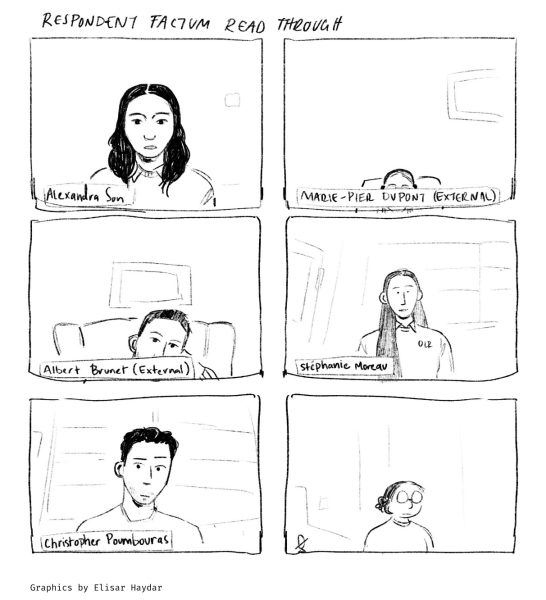
It is a well-known fact that lawyers love to win.1 So it’s only natural that law students—whether by nature or through the intense nurture of law school—also love to win. For the law student, nothing triggers the release of dopamine more than the “A” printed on the transcript, the email that starts with “Congratulations”, and the call that begins with “We’d love to offer you…”. After all, that’s what law school is all about. Winners = best lawyers = happy life.
So when our team didn’t make it to the semifinals at this year’s Laskin Moot Competition, the vibes were bleak. It felt like all the time we put into the competition were for nothing. Months of research, writing a dozen factum drafts, and at least 40 hours of oral practices—and no trophy to show for it. To make matters worse, we had the unfortunate pleasure of being the first uOttawa team to not bring home a prize in seven years.
uOttawa’s generally fantastic performance at advocacy competitions “across Canada and around the world” didn’t really help us feel any better.2 From the Charles Rousseau International Law Moot to the Canadian Client Consultation Competition, uOttawa mooting teams obviously slayed. It unfortunately made us feel extra awkward when people asked “oh how was your moot!” and we had to say “oh it was fine! We didn’t win anything… but it’s fine!”3
But it turns out we actually were fine (although it took some of us a lot longer to get over it than others). We went for soup dumplings, which helped us think about whether we’d do it all over again despite our lackluster outcome, and surprisingly all of us said absolutely yes.4
This is our moot reflection about our moot experience.
TL;DR? Everyone should moot—even if you don't win.
The Laskin & How We Got There
The Laskin Moot is a national bilingual moot competition that focuses on constitutional and administrative law. Every team has to have at least one English mooter and one French mooter, and is hosted at a different city in Canada every year. We heard that Calgary was a popular location—Winnipeg not so much. Our team formed in mid-October with one French mooter and three English mooters.
The 2025 problem was an obscure question about the federal government’s ability to validly enact environmental legislation. It had con and admin law issues about the federal declaratory power. POGG. Double aspect. Improper purpose. Charter values. Reasonableness. Only half of our team had taken both Constitutional Law 2 and Administrative Law at that point so we were undoubtedly off to a somewhat rocky start.
We kicked things off by reading 1,025 pages of case law cited in the moot problem. The first case (Reference re Greenhouse Gas Pollution Pricing Act5) was mildly interesting. The last case (CUPE v New Brunswick Liquor Corporation6) was aggressively not.
Our first factum draft was due three days before the December exam season—and by the time we submitted the final drafts to the competition, we had gone through a dozen drafts.
We pulled more all-nighters than we had ever pulled in law school, and most of us hit new personal records on Celcius consumption. We had all written factums before (whether it was a lame one for 1L Torts class or a cool one for our summer jobs7) but drafting an argument from scratch on legal topics we had never heard of was really something else. On a positive note, the factums went through a lot of changes and draft 1 looked nothing like draft 12. On the downside…our tab count was ungodly, we could never shut our laptops off (because of the tabs), and we were eventually running on very little sleep.
Three days after our factums were submitted, we jumped into oral practices. We met two to four times a week and practiced in front of a diverse collection of guest judges—from last year’s Laskin team (who won) to senior partners at national firms. And then we practiced again. And again. And then some more.
The Competition (& How We Broke Our Coaches’ Seven Year Winning Streak)
Eventually all our practices came to an end, and it was competition weekend. Not gonna lie, at that point, we were feeling pretty good about how we were practicing. We could all answer questions from judges without hesitation.
Competition weekend started—as one might expect in late February in Canada—with a snowstorm. We took the train from Ottawa to Montreal, which meant most of Friday was spent staring out a frosted window, delayed and disoriented, wondering if VIA Rail was ever legally obligated to be on time.
By the time we arrived at the hotel, things already felt a little overwhelming. The lobby was full of law students—and some of them were really going all in with matching neon tracksuits and team t-shirts with Justice Laskin’s face on them. Our welcome event followed, where we met other mooters from across the country (from UBC to UNB—truly coast to coast). We were collectively disappointed to find out that this year’s Laskin wasn’t on an open bar system, and we were each given six drink tickets to last the entire weekend. Not that it mattered because we didn’t use ours—we went back to our hotel rooms to practice.
By 1AM, we decided to call it a night. We were tired; the kind of tired where you know more questions won’t help and you start mumbling your submissions to the ceiling like a bedtime story. We left it to the universe and went to sleep.
Both our appellant team and respondent team had to get up at the break of dawn to go to Montreal’s Federal Court building. The appellants were going first, at 8AM, and the respondents followed at 10. The actual rounds generally went well—we had great arguments, we answered all the questions, we didn’t speak too fast, and we didn’t say “obviously” to the judges. We did it all over again the next day.
Semifinalists were announced by 3PM on day 2. If you haven’t guessed yet, we weren’t on the list.
The thing about moot competitions is that scores aren’t always a clean reflection of performance. Different judges score different teams, and each judge has their own vision of what a “good oral advocate” looks and sounds like. It’s not always about the strength of the legal argument—it’s style, clarity, courtroom presence. And those preferences vary wildly. So in hindsight, maybe it wasn’t a big deal.
Obviously it still really sucked.8 By the awards ceremony that night, we had a feeling we wouldn’t win anything. But when we actually didn’t win anything—not even the fourth best factum prize—the feeling hit different. It made us question our oral and written advocacy skills.
By the awards ceremony that night, we had a feeling we wouldn’t win anything. But when we actually didn’t win anything—not even the fourth best factum prize—the feeling hit different. It made us question our oral and written advocacy skills. Were our arguments incoherent? Did we completely misunderstand the problem? Was our research completely irrelevant to what the judges were looking for? Our rational brains said no—but the heart isn’t always rational.
It felt even worse knowing that last year’s uOttawa team swept. They won top school, top oralist, and top pair. And here we were, breaking our coaches’ winning streak. We knew that they put in a lot of after-work hours for us, despite leading very busy lives outside of the law.
But our coaches were incredible throughout the whole process—including when the competition was over. They were present, kind, and unwaveringly supportive. When we didn’t place, they told us they were proud and that they’d seen how hard we worked. That we gave our best performances during the competition.
And that meant more than any trophy. Maybe it’s because most law students are hardwired people-pleasers—or maybe just because it seemed like they actually meant it.
Our Moot (But Hopefully Insightful) Point
We (as previously established) love to win. So much so that sometimes we avoid things we’re not sure we can win. Mooting messes with that instinct. Because even when you do everything right, you still might not come home with anything.
And we think that’s the biggest gift Laskin has given us. Mooting reminds us that even great lawyers who put in a lot of effort lose. What matters more is what you take away from each experience: how to argue clearly, write tightly, think fast, work with a team, and survive stressful times. It’s one of the few spaces in law school where you get to take risks, try new ideas, and be genuinely creative without the pressure of real-world consequences.
It also teaches you something law school usually doesn’t: “Results are critical. But it’s the process that leads us there that truly defines who we are.”9 Alex loves this quote!
So that’s our moot (but hopefully insightful) point. Also, climate change is threatening our world so make sure to recycle!